For many investors, building a portfolio is not only about long-term growth. As markets mature and interest rate environments change, consistent income becomes just as important as capital appreciation. This is especially true for investors seeking cash flow, portfolio stability, or psychological comfort during volatile periods.
This is why US dividend ETFs and monthly dividend ETFs continue to attract attention. These funds offer structured exposure to income-generating stocks while maintaining diversification and liquidity. However, not all dividend ETFs serve the same purpose. Some focus on steady quarterly payouts from financially strong companies, while others aim to deliver monthly income with different risk profiles.
This article is designed to help you clearly compare US dividend ETFs and monthly dividend ETFs. Rather than promoting specific products, it explains how these ETF types work, why investors choose them, and what trade-offs they involve. By understanding these differences, you can decide which approach aligns best with your income needs, time horizon, and tolerance for risk.
Market Context: Why Dividend ETFs Matter Today
Dividend-focused investing has regained relevance in recent years. Higher interest rates, uneven market performance, and increased uncertainty have shifted investor priorities toward reliability and cash flow.
Market factor | Why it matters
Interest rates | Income alternatives are more visible
Market volatility | Dividends reduce reliance on price gains
Aging investors | Demand for predictable cash flow
Earnings focus | Strong balance sheets are rewarded
In this environment, dividend ETFs are often used as stabilizing components within a broader portfolio. Monthly dividend ETFs, in particular, appeal to investors who value frequent income, even if it comes with different structural risks.
Understanding this context helps frame the discussion around US dividend ETFs and monthly dividend ETFs as tools for income planning rather than short-term performance chasing.

Comparing US Dividend ETFs and Monthly Dividend ETFs
US Dividend ETFs
US dividend ETFs typically invest in companies with a history of consistent dividend payments and strong financial fundamentals. Distributions are usually paid quarterly.
These ETFs emphasize sustainability over yield maximization. Many prioritize dividend growth, payout ratios, and balance sheet strength.
(Why Investors Choose US Dividend ETFs)
Benefit | Practical impact
Dividend income | Regular cash flow
Lower volatility | Smoother portfolio performance
Financial strength | Better downside resilience
(Trade-Offs)
Limitation | Explanation
Lower yield | Focus on sustainability
Quarterly payments | Less frequent income
Who They Fit Best
- Long-term income investors
- Risk-conscious portfolios
- Investors prioritizing stability over yield
US dividend ETFs are often considered a core income holding due to their balance between reliability and diversification.
Monthly Dividend ETFs
Monthly dividend ETFs distribute income every month rather than quarterly. They often include a mix of dividend stocks, income strategies, or asset-backed structures.
The main appeal is cash flow frequency. For some investors, monthly income aligns better with living expenses or reinvestment strategies.
(Why Investors Choose Monthly Dividend ETFs)
Benefit | Practical impact
Monthly income | Predictable cash flow timing
Psychological comfort | Easier budgeting
Reinvestment flexibility | Faster compounding cycles
(Trade-Offs)
Limitation | Explanation
Higher complexity | Strategy driven payouts
Yield variability | Income may fluctuate
Higher costs | More active structures
Who They Fit Best
- Income-dependent investors
- Retirees managing cash flow
- Investors comfortable with structural risk
Monthly dividend ETFs can be useful, but they require closer understanding of how distributions are generated.
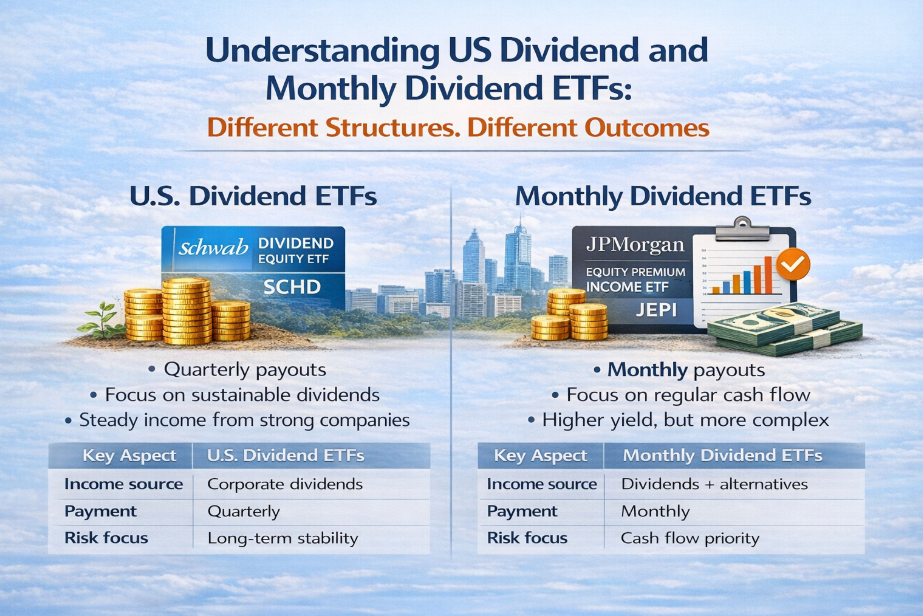
Key Differences at a Glance
ETF type | Payment frequency | Risk profile
US dividend ETF | Quarterly | Low to medium
Monthly dividend ETF | Monthly | Medium to high
The difference is not only timing, but also structure. Monthly payouts do not automatically mean higher income quality. Evaluating sustainability matters more than frequency.
Practical Decision Guide
Investor profile | Better fit option
Long-term income focus | US dividend ETF
Monthly cash flow need | Monthly dividend ETF
Risk conservative | US dividend ETF
Yield oriented | Monthly dividend ETF
Before choosing, consider:
- Do I need income monthly or quarterly?
- Can I tolerate income variability?
- Is sustainability more important than yield?
Many investors combine both types, using US dividend ETFs as a stable base and monthly dividend ETFs as supplemental income tools.

Conclusion
Choosing between US dividend ETFs and monthly dividend ETFs is ultimately about aligning income structure with personal needs. US dividend ETFs offer stability, sustainability, and long-term reliability. Monthly dividend ETFs provide frequent income but often involve higher complexity and risk.
Neither approach is inherently better. The right choice depends on how income fits into your overall financial plan. By understanding the benefits and trade-offs of each, investors can build income-focused portfolios with greater clarity and confidence.


