When investing in U.S. stocks, many people focus on dividend payments as a source of steady income. However, a key concept that often confuses investors is the ex-dividend date—the day after which new shareholders are no longer entitled to the upcoming dividend. Understanding the U.S. ex-dividend policy is essential to make informed decisions about when to buy or sell dividend-paying stocks.
In this article, we will explore how the U.S. dividend system works, compare different strategies around the ex-dividend date, explain its impact on stock prices, and guide you on making practical decisions based on your financial goals. By the end, you’ll know not only what the ex-dividend date is but also how to use this knowledge effectively without unnecessary risk.
Market Overview: U.S. Dividend Policies and Trends
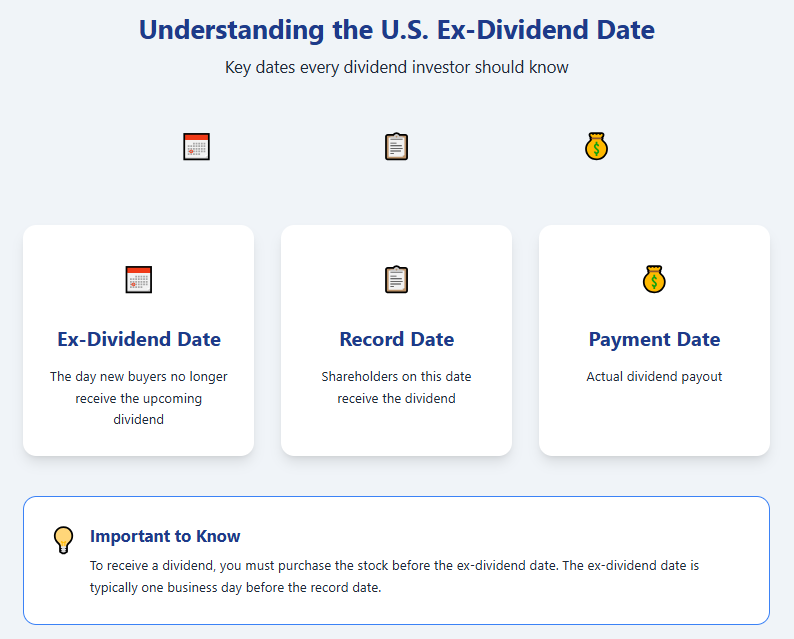
In the United States, dividend distribution is governed by rules set by the Securities and Exchange Commission (SEC) and the stock exchanges where the company is listed. A typical dividend cycle includes four critical dates:
- Declaration Date – The company announces the dividend.
- Record Date – Shareholders on record by this date are entitled to the dividend.
- Ex-Dividend Date – Usually one business day before the record date; new buyers on or after this day do not receive the dividend.
- Payment Date – The day the dividend is actually paid to eligible shareholders.
Why the ex-dividend date matters
The ex-dividend date is particularly important because it determines who legally receives the dividend, and it also influences short-term stock price movement. Typically, a stock’s price drops roughly by the dividend amount on the ex-dividend date, reflecting the outgoing cash flow from the company. This adjustment is automatic in theory, though market factors can create slight deviations.
Trends in U.S. dividend-paying stocks
- Steady growth in dividends among S&P 500 companies, particularly in consumer staples and utilities.
- Dividend reinvestment plans (DRIPs) allow investors to automatically reinvest dividends, amplifying long-term growth.
- A focus on tax efficiency, since qualified dividends are taxed differently than ordinary income.
Understanding these structural and market trends helps investors align ex-dividend strategies with long-term objectives rather than short-term speculation.
In-Depth Comparison: Ex-Dividend Strategies
Option 1: Buying Before the Ex-Dividend Date
Overview: Purchase shares before the ex-dividend date to qualify for the dividend payout.
Strengths:
- Guarantees the upcoming dividend.
- Useful for investors seeking steady income streams.
Limitations:
- Stock price typically drops by the dividend amount on the ex-dividend date.
- Transaction costs or short-term price volatility may offset small dividend gains.
Ideal for: Income-focused investors who prefer predictable cash flow, not short-term traders.
Option 2: Buying On or After the Ex-Dividend Date
Overview: Buy shares on or after the ex-dividend date; you will not receive the current dividend.
Strengths:
- Stock may be temporarily undervalued after the price adjustment.
- Opportunity to buy shares at a slightly lower price without missing long-term growth.
Limitations:
- Missed dividend income for that cycle.
- Price adjustment may not always match the dividend exactly due to market dynamics.
Ideal for: Long-term investors focusing on capital appreciation rather than immediate dividend income.

Option 3: Dividend Capture Strategy
Overview: Intentionally buy shares just before the ex-dividend date and sell shortly after collecting the dividend.
Strengths:
- Can provide short-term income if executed correctly.
Limitations:
- High risk due to transaction costs and potential price drop greater than the dividend.
- Not tax-efficient in the U.S.; short-term gains are taxed at higher ordinary income rates.
Ideal for: Sophisticated investors aware of risks and willing to actively monitor the market.
Practical Decision Guide: How to Use Ex-Dividend Knowledge
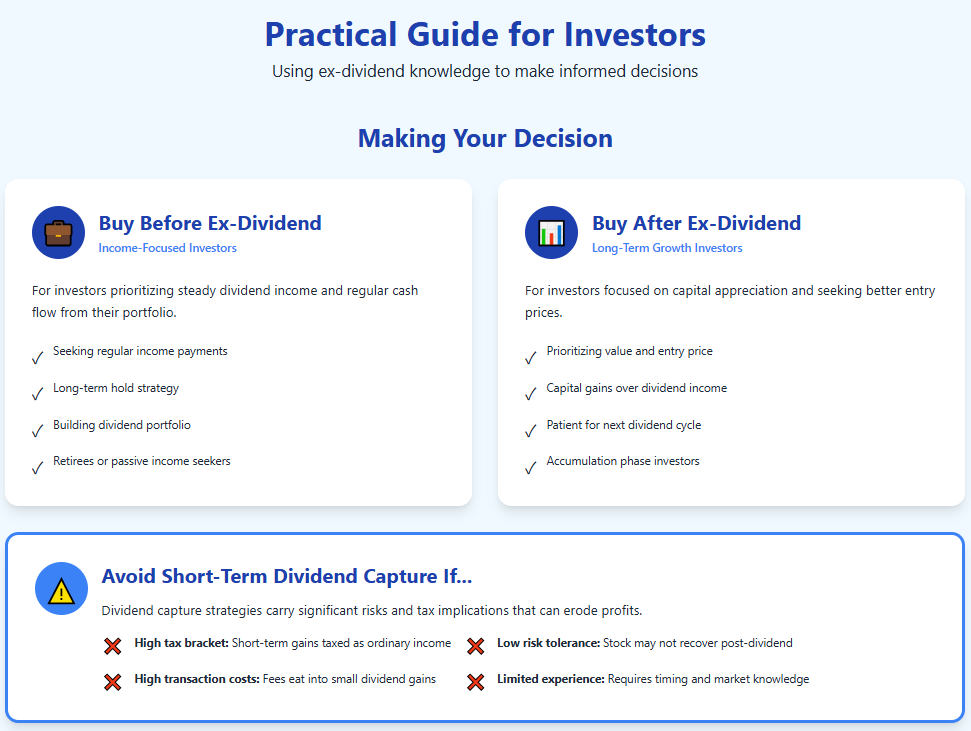
- Income-focused investors – Buy before the ex-dividend date if your goal is steady dividend cash flow.
- Long-term growth investors – Consider buying after the ex-dividend date to benefit from potential temporary price drop.
- Short-term traders – Avoid relying solely on dividend capture; the risk-to-reward ratio is often unfavorable.
- Tax-aware investors – Factor in dividend taxation to decide if the immediate payout is worth potential short-term capital loss.
By understanding these factors, you can make choices aligned with your investment horizon, risk tolerance, and income goals rather than chasing dividends blindly.
Frequently Asked Questions (FAQ)
Q1: What happens if I sell before the ex-dividend date?
You will not receive the dividend. Only shareholders of record by the record date are entitled.
Q2: Does the stock price always drop by the dividend amount?
Not always. While the theoretical drop equals the dividend, market demand and broader trading activity may cause variations.
Q3: How is the ex-dividend date determined in the U.S.?
Typically, it is one business day before the record date, following SEC rules and exchange regulations.
Q4: Can dividends be automatically reinvested?
Yes, many U.S. brokers offer Dividend Reinvestment Plans (DRIPs), which help compound returns over time.

Conclusion: Making Informed Choices Around Ex-Dividend Dates
Understanding the U.S. ex-dividend date is crucial for aligning your stock purchases with your financial objectives.
- Buying before the ex-dividend date secures dividend income but carries short-term price adjustment risk.
- Buying after the ex-dividend date may allow slightly cheaper entry for long-term growth.
- Dividend capture strategies are possible but involve higher risk and tax considerations.
By carefully considering your investment horizon, income needs, and market context, you can make informed decisions about dividend-paying stocks without falling into common pitfalls. Ex-dividend knowledge empowers you to balance income, price movement, and long-term growth effectively.


