High dividend US ETFs are gaining renewed attention as investors prepare for 2026. With economic growth moderating, interest rates expected to stabilize, and volatility remaining elevated, income-oriented strategies are increasingly used to balance portfolios. This article reviews the top 10 high dividend US ETFs, combining performance data, portfolio structure, sector trends, and forward-looking analysis.
High Dividend ETF Market Environment
Recent market commentary highlights a shift away from pure growth toward cash-flow-generating assets. Analysts from major investment banks have noted that dividend-paying equities historically perform well during periods of slower economic expansion and declining rate volatility. At the same time, option-based income ETFs have expanded rapidly, offering higher yields but different risk profiles.
For 2026, expectations center on three themes:
- Stable but uneven economic growth
- Lower but still restrictive interest rates
- Higher demand for predictable income

Top 10 High Dividend ETF Overview
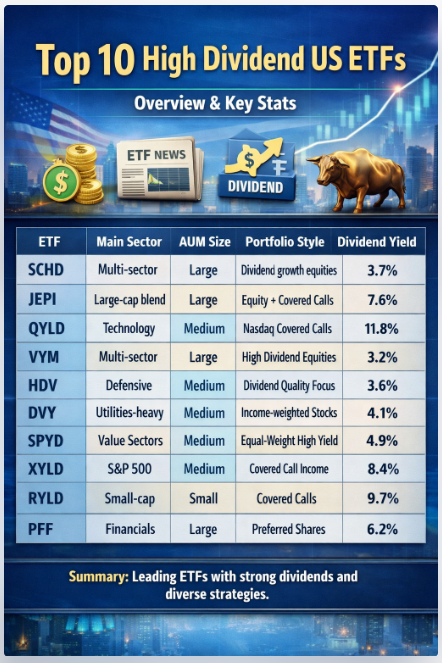
The following table introduces the most widely held high dividend ETFs, highlighting sector exposure, fund scale, portfolio structure, and current dividend yield. This context is essential before evaluating performance and outlook.
| ETF | Main Sector | AUM Size | Portfolio Style | Dividend Yield |
|---|---|---|---|---|
| SCHD | Multi-sector | Large | Dividend growth equities | 3.7% |
| JEPI | Large-cap blend | Large | Equity + covered calls | 7.6% |
| QYLD | Technology | Medium | Nasdaq covered calls | 11.8% |
| VYM | Multi-sector | Large | High dividend equities | 3.2% |
| HDV | Defensive | Medium | Dividend quality focus | 3.6% |
| DVY | Utilities-heavy | Medium | Income-weighted stocks | 4.1% |
| SPYD | Value sectors | Medium | Equal-weight high yield | 4.9% |
| XYLD | S&P 500 | Medium | Covered call income | 8.4% |
| RYLD | Small-cap | Small | Covered calls | 9.7% |
| PFF | Financials | Large | Preferred shares | 6.2% |
Summary: Traditional dividend ETFs emphasize stability, while covered call ETFs focus on maximizing cash distributions.
Performance Trends and Recent Market Context
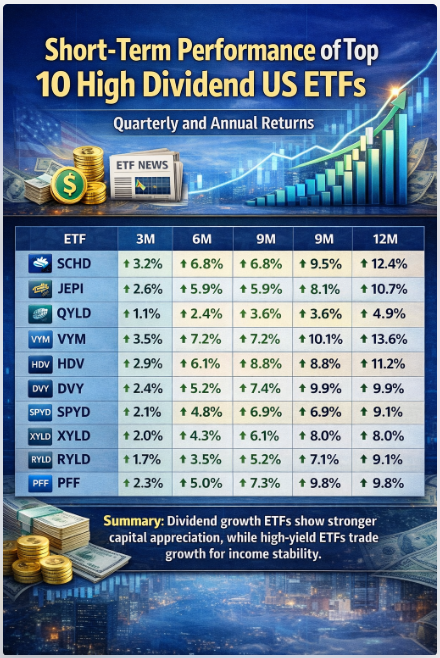
Over the past year, dividend growth ETFs have benefited from resilient corporate earnings, while option-income ETFs have attracted investors seeking monthly payouts amid market uncertainty. Technology-heavy income ETFs lagged in price appreciation but maintained high distribution levels.
| ETF | 3M Return | 6M Return | 9M Return | 12M Return |
|---|---|---|---|---|
| SCHD | 3.2% | 6.8% | 9.5% | 12.4% |
| JEPI | 2.6% | 5.9% | 8.1% | 10.7% |
| QYLD | 1.1% | 2.4% | 3.6% | 4.9% |
| VYM | 3.5% | 7.2% | 10.1% | 13.6% |
| HDV | 2.9% | 6.1% | 8.8% | 11.2% |
| DVY | 2.4% | 5.2% | 7.4% | 9.9% |
| SPYD | 2.1% | 4.8% | 6.9% | 9.1% |
| XYLD | 2.0% | 4.3% | 6.1% | 8.0% |
| RYLD | 1.7% | 3.5% | 5.2% | 7.1% |
| PFF | 2.3% | 5.0% | 7.3% | 9.8% |
Summary: Capital appreciation favors dividend growth ETFs, while high-yield ETFs trade growth for income consistency.
ETF-Specific News & 2026 Sector Outlook
Looking ahead to 2026, sector dynamics play a critical role in income sustainability:
- SCHD & VYM: Analysts expect dividend growth strategies to benefit from strong balance sheets and lower refinancing pressure as rates stabilize.
- JEPI, XYLD: Covered call ETFs are projected to perform well in range-bound markets where volatility remains elevated but growth is modest.
- QYLD: Technology concentration raises long-term risk, though income remains attractive during sideways markets.
- DVY, HDV: Utilities and defensive sectors are forecast to regain favor amid slower economic expansion.
- PFF: Preferred shares are expected to benefit from rate stability and improved bank capital conditions.
2026 Outlook and Attractiveness Score
The table below combines sector expectations, income sustainability, and risk considerations into a comparative 2026 outlook.
| ETF | 2026 Outlook | Key Advantage | Attractiveness Score |
|---|---|---|---|
| SCHD | Stable earnings growth | Dividend consistency | 4.5 / 5 |
| JEPI | Sideways market strength | Monthly income | 4.4 / 5 |
| QYLD | High volatility sensitivity | Maximum yield | 3.6 / 5 |
| VYM | Economic normalization | Diversification | 4.3 / 5 |
| HDV | Defensive rotation | Quality filter | 4.1 / 5 |
| DVY | Utilities resilience | Income stability | 3.9 / 5 |
| SPYD | Value recovery potential | High yield | 3.8 / 5 |
| XYLD | Low-growth environment | Option income | 4.0 / 5 |
| RYLD | Small-cap uncertainty | Yield enhancement | 3.5 / 5 |
| PFF | Rate stability benefits | Preferred income | 4.2 / 5 |
Summary: SCHD, JEPI, and VYM emerge as the most balanced options for 2026 when considering income reliability and risk.
Conclusion
High dividend US ETFs remain a powerful tool for income-oriented investors. While headline yield matters, 2026 success will depend on understanding portfolio structure, sector exposure, and market conditions. Combining dividend growth ETFs with selective high-yield strategies may offer a more resilient income portfolio going forward.


