Every year, Apple’s iPhone release sets the tone for the global smartphone market. For many users, upgrading an iPhone is not just about getting a new device — it’s about deciding when meaningful innovation truly arrives. As we move closer to iPhone 2026, consumers are increasingly asking the same questions: How different will the next iPhone really be? Is it worth waiting? And how does it compare to previous generations?
The iPhone 2026 is expected to represent a turning point in Apple’s long-term product strategy. With growing focus on artificial intelligence, on-device processing, and deeper ecosystem integration, Apple appears to be shifting from incremental upgrades to more experience-driven innovation. This makes understanding the evolution of the iPhone — from its early design language to its current performance-focused models — more important than ever.
This article provides a clear, research-based breakdown of iPhone history, design evolution, and technological progress, followed by a detailed comparison between existing models and the expected iPhone 2026 lineup. Whether you are planning to upgrade soon or simply want to understand where Apple is heading, this guide is designed to help you make a well-informed decision.
iPhone Evolution: Market Overview and Design History
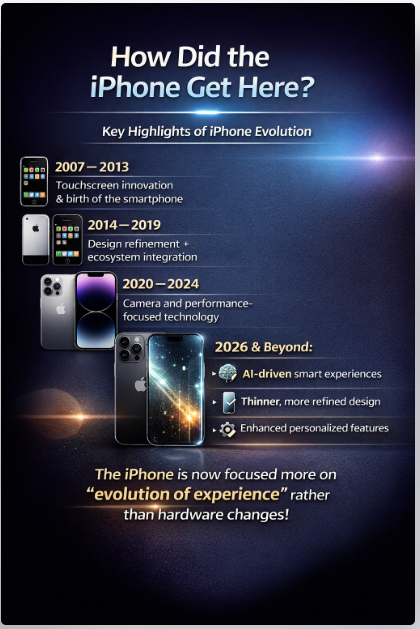
Since its introduction in 2007, the iPhone has consistently shaped the smartphone market. Early generations focused on redefining mobile interaction through touchscreens and intuitive software. Over time, Apple shifted toward performance optimization, ecosystem integration, and long-term software support — areas where it continues to differentiate itself.
Key Phases of iPhone Evolution
1. Early Innovation Era (2007–2013)
The first iPhones introduced multi-touch displays, simplified interfaces, and a new mobile internet experience. Design was centered on physical simplicity, with a strong emphasis on hardware quality.
2. Performance & Ecosystem Expansion (2014–2019)
With the introduction of larger displays, Touch ID, Face ID, and improved camera systems, Apple focused on usability and security. The iPhone became deeply integrated with iCloud, Apple Watch, and Mac devices.
3. Computational & Camera Era (2020–2024)
Recent models emphasized computational photography, AI-driven image processing, 5G connectivity, and powerful custom silicon. Apple’s A-series chips became industry benchmarks for mobile performance.
4. Transition Toward On-Device Intelligence (2025–2026)
The upcoming generation, including the iPhone 2026, is expected to focus on AI-powered features, energy efficiency, and deeper personalization. Rather than radical redesigns, Apple appears to be refining the user experience at a system level.
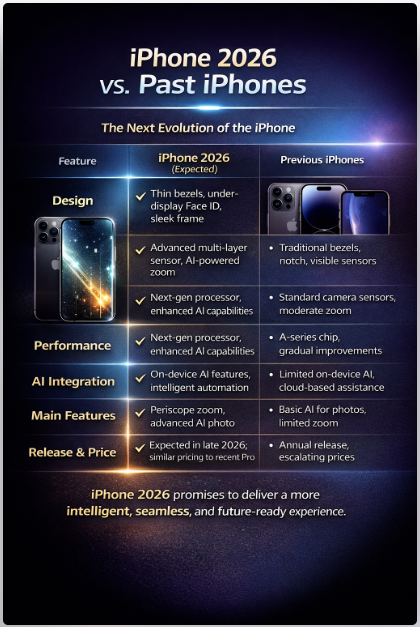
iPhone 2026 vs Previous Generations: In-Depth Comparison
Design & Build Quality
Earlier iPhones prioritized sleek minimalism with incremental refinements. From aluminum bodies to stainless steel and later titanium frames, Apple’s material choices have balanced durability and aesthetics.
The iPhone 2026 is expected to continue using premium materials while reducing visible hardware elements. Industry analysts suggest:
- Slimmer bezels with improved screen-to-body ratio
- Under-display Face ID or advanced sensor integration
- Lighter yet stronger frame materials
The goal appears to be a more immersive, distraction-free front design without sacrificing durability.
Camera System Evolution
Apple’s camera improvements have historically focused on computational photography rather than sheer megapixel count.
| Main Sensor | 48MP | Enhanced multi-layer sensor |
| Low-Light Performance | Strong | AI-assisted night processing |
ZoomOptical 3–5xPeriscope-style optical zoomVideo4K ProResAdvanced AI stabilization + real-time HDR
The iPhone 2026 camera is expected to rely heavily on on-device AI to improve image quality, scene recognition, and video stabilization without heavy post-processing.
Performance & Processing Power
Apple’s A-series chips already outperform many desktop-class processors in efficiency. The upcoming generation is likely to introduce:
- A next-generation 3nm or smaller process chip
- Dedicated AI and neural processing cores
- Improved thermal management for sustained performance
Rather than focusing solely on raw speed, Apple appears to be optimizing for real-world performance, such as multitasking, on-device AI inference, and battery efficiency.
AI and Smart Features
One of the biggest differentiators for the iPhone 2026 is expected to be deeper on-device AI integration. This may include:
- More intelligent Siri interactions
- Context-aware automation
- Enhanced privacy through local AI processing
- Smarter photo, video, and text recognition
Unlike cloud-based AI models, Apple’s approach emphasizes privacy-first intelligence that runs directly on the device.
Expected Release Date, Pricing & Pre-Order Timeline
While Apple has not officially announced details, historical patterns provide reasonable expectations:
| Announcement | September 2026 |
| Pre-orders | 1 week after launch event |
| Retail Availability | Late September 2026 |
| Starting Price | Similar to prior Pro models, adjusted for inflation |
Pricing is expected to remain in line with previous flagship models, with higher tiers for advanced storage and Pro features.
Practical Decision Guide
Who Should Consider Waiting for iPhone 2026?
- Users with iPhone 12 or older devices
- Those interested in AI-driven features and long-term software support
- Creators who rely on camera performance and on-device processing
Who Might Not Need to Upgrade?
- Users with recent Pro models (iPhone 14/15 Pro)
- Those satisfied with current performance and battery life
- Users who prioritize cost over cutting-edge features
Best Use Cases
The iPhone 2026 is likely best suited for professionals, content creators, and users who want a future-ready device with strong longevity.

Conclusion
The iPhone 2026 represents a natural evolution rather than a radical reinvention. Apple appears focused on refining the user experience through smarter software, efficient hardware, and deeper AI integration. While design changes may be subtle, the real transformation lies in how the device understands and adapts to its user.
For buyers deciding whether to upgrade, the key question is not just what’s new, but how much value those improvements bring to daily use. By understanding the differences between past and upcoming models, consumers can make informed, confident decisions that align with their needs and timelines.
As Apple continues to refine its long-term vision, the iPhone 2026 stands as a clear indicator of where mobile technology is headed next.
'▶America◀ > IT information' 카테고리의 다른 글
| 2026 Costco Refrigerator Discount Brand Comparison Review – Samsung vs LG vs GE Price & Best Deals (0) | 2026.01.31 |
|---|
